


Translated by Google
Artificial intelligence for seniors and the use of basic software

From 22.83 € /h

Objective: To understand AI without fear, to use it to simplify one's life, to know how to identify digital traps, and to use Word, Excel, etc. without difficulty.
1: Demystifying AI (What exactly is it?)
AI is not a movie robot: Difference between fiction and reality.
How it works (simply): The image of the "giant library": AI has read billions of books and uses them to predict the continuation of a sentence or create an image.
Where is it already present? Spell checkers, Netflix/YouTube suggestions, GPS, and voice assistants (Siri/Alexa).
2: Using AI to make life easier
Conversing with AI (ChatGPT, Claude, Gemini):
Ask him to write an administrative email or a complex letter.
Summarize a long newspaper article or document.
Plan a travel itinerary or find recipe ideas with what's left in the fridge.
AI for creativity and memory:
Generate images to illustrate a birthday card (Midjourney, DALL-E).
Using AI to restore or colorize old family photos.
3: Learning to "talk" to AI (The Art of the Prompt)
The context method: Why "Give me a cake recipe" is less effective than "I am allergic to gluten and I am hosting 4 people, give me a simple chocolate cake recipe".
The expert's role: Learning to tell AI "Act like a travel guide" or "Act like an expert gardener".
4: Precautions and Critical Thinking (The Survival Guide)
"Hallucinations": Understand that AI can make false claims with complete certainty (never take medical or legal advice from AI without verification).
Privacy protection:
Never give sensitive data (social security number, passwords, bank details) to an AI.
Knowing that everything we write to the AI is potentially used to train it.
Spotting "Deepfakes":
How to recognize a doctored image or video (details on the hands, strange reflections, slightly metallic voice).
Verify the information: the golden rule of cross-referencing sources.
5: Ethics and Impacts (To go further)
Copyright: Who owns an image created by AI?
The environmental impact: The water and energy consumption of AI servers.
The future: Will AI replace us or assist us?
1: Demystifying AI (What exactly is it?)
AI is not a movie robot: Difference between fiction and reality.
How it works (simply): The image of the "giant library": AI has read billions of books and uses them to predict the continuation of a sentence or create an image.
Where is it already present? Spell checkers, Netflix/YouTube suggestions, GPS, and voice assistants (Siri/Alexa).
2: Using AI to make life easier
Conversing with AI (ChatGPT, Claude, Gemini):
Ask him to write an administrative email or a complex letter.
Summarize a long newspaper article or document.
Plan a travel itinerary or find recipe ideas with what's left in the fridge.
AI for creativity and memory:
Generate images to illustrate a birthday card (Midjourney, DALL-E).
Using AI to restore or colorize old family photos.
3: Learning to "talk" to AI (The Art of the Prompt)
The context method: Why "Give me a cake recipe" is less effective than "I am allergic to gluten and I am hosting 4 people, give me a simple chocolate cake recipe".
The expert's role: Learning to tell AI "Act like a travel guide" or "Act like an expert gardener".
4: Precautions and Critical Thinking (The Survival Guide)
"Hallucinations": Understand that AI can make false claims with complete certainty (never take medical or legal advice from AI without verification).
Privacy protection:
Never give sensitive data (social security number, passwords, bank details) to an AI.
Knowing that everything we write to the AI is potentially used to train it.
Spotting "Deepfakes":
How to recognize a doctored image or video (details on the hands, strange reflections, slightly metallic voice).
Verify the information: the golden rule of cross-referencing sources.
5: Ethics and Impacts (To go further)
Copyright: Who owns an image created by AI?
The environmental impact: The water and energy consumption of AI servers.
The future: Will AI replace us or assist us?
Extra information
To be smart with artificial intelligence despite your age!
Location

Online from Luxembourg
About Me
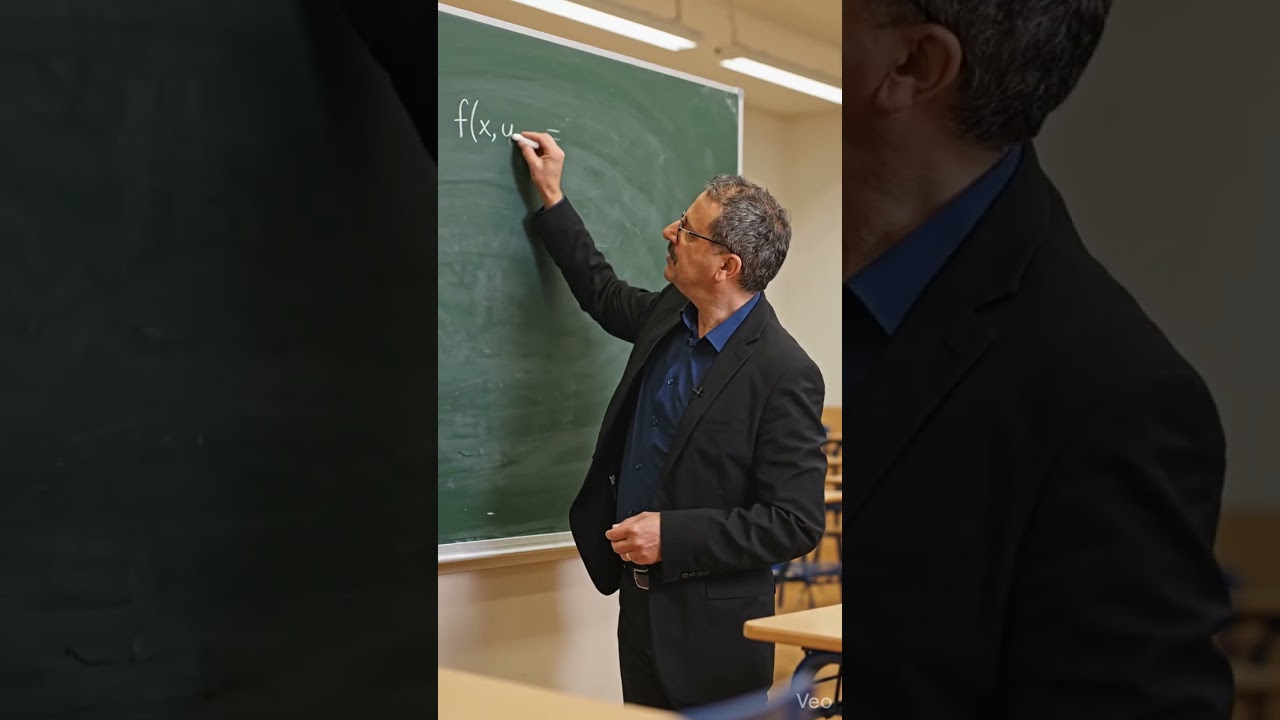
Dr. Raouf holds a PhD in Mathematics and has extensive experience in higher education and personalized academic support. I guide high school students (both academic and general) and university students toward excellence.
My teaching method is based on simplifying abstract concepts and mastering problem-solving methods.
1. Secondary Education
Analysis: In-depth study of functions (logarithms, exponentials), limits, derivatives and integral calculus.
Linear Algebra: Analytic geometry in space, vectors, and systems of equations (Gaussian method).
Complex Numbers: Algebraic, trigonometric forms and resolution in .
Preparation for the Final Examination: Intensive work on past exam papers (Past papers).
2. Higher Education
Calculus & Real Analysis: Sequences, series, generalized integrals.
Matrix algebra: Vector spaces, diagonalization, eigenvalues.
My Online Methodology
Digital tools: A shared Word document is used in real time to explain the lesson and complete exercises. This document is sent to the student as a PDF at the end of the lesson.
Personalized follow-up: Sending a summary of the lesson and application exercises after each session.
My teaching method is based on simplifying abstract concepts and mastering problem-solving methods.
1. Secondary Education
Analysis: In-depth study of functions (logarithms, exponentials), limits, derivatives and integral calculus.
Linear Algebra: Analytic geometry in space, vectors, and systems of equations (Gaussian method).
Complex Numbers: Algebraic, trigonometric forms and resolution in .
Preparation for the Final Examination: Intensive work on past exam papers (Past papers).
2. Higher Education
Calculus & Real Analysis: Sequences, series, generalized integrals.
Matrix algebra: Vector spaces, diagonalization, eigenvalues.
My Online Methodology
Digital tools: A shared Word document is used in real time to explain the lesson and complete exercises. This document is sent to the student as a PDF at the end of the lesson.
Personalized follow-up: Sending a summary of the lesson and application exercises after each session.
Education
Master's degree in Mathematics. PhD in Applied Mathematics. Mathematical researcher at the Modeling Laboratory of the National Engineering School of Tunis. My areas of expertise in mathematics range from the foundational concepts acquired during secondary education to advanced mathematics at the Bachelor's and Master's levels, as well as preparatory classes for engineering studies. I am also proficient in the numerical analysis and functional analysis curricula taught in engineering schools.
Experience / Qualifications
A career spanning more than 20 years in an engineering school in Tunisia whose training programs are EUR-ACE accredited.
Age
Adults (18-64 years old)
Seniors (65+ years old)
Student level
Beginner
Duration
60 minutes
The class is taught in
French
English
Arabic

Reviews
Availability of a typical week
(GMT -04:00)
New York

Online via webcam
Mon
Tue
Wed
Thu
Fri
Sat
Sun
00-04
04-08
08-12
12-16
16-20
20-24
As an experienced mathematics teacher, I offer online private tutoring for high school and university students in Belgium, France, and Switzerland. My courses cover the entire curriculum, from secondary school through the first years of university in science, economics, or engineering.
- For high school students: strengthening of the basics in algebra, geometry and analysis, homework help, preparation for official exams (Higher Secondary Education Certificate, Baccalaureate, specific tests).
- For students: advanced university mathematics with a focus on analysis, linear algebra and numerical methods.
My teaching methods are adapted to the online format, with clear explanations, interactive exercises, and personalized support to ensure progress. The first session is for a precise assessment of your needs.
Key points
- Flexible courses (1 to 2 hours per session) via videoconference using Zoom or Teams.
- Use of digital tools to facilitate understanding (interactive whiteboards, screen sharing).
- Direct application to Belgian programs and requirements of school and university examinations.
- For high school students: strengthening of the basics in algebra, geometry and analysis, homework help, preparation for official exams (Higher Secondary Education Certificate, Baccalaureate, specific tests).
- For students: advanced university mathematics with a focus on analysis, linear algebra and numerical methods.
My teaching methods are adapted to the online format, with clear explanations, interactive exercises, and personalized support to ensure progress. The first session is for a precise assessment of your needs.
Key points
- Flexible courses (1 to 2 hours per session) via videoconference using Zoom or Teams.
- Use of digital tools to facilitate understanding (interactive whiteboards, screen sharing).
- Direct application to Belgian programs and requirements of school and university examinations.
1. Algebra and linear algebra
The foundation of success in mathematics. General algebra: groups, rings, fields and arithmetic.
Linear algebra: Vector spaces, reduction of endomorphisms (diagonalization, triangularization), duality and quadratic forms.
2. Topology and Functional Analysis
Metric spaces and topology: open and closed sets, compactness, convexity.
Normed vector spaces: convergence of sequences, continuity and equivalence of norms.
Banach & Hilbert spaces: study of completeness, orthogonal projections, Riesz theorems and Fourier series.
3. Numerical Analysis: The art of solving mathematical problems using algorithms and high-performance computing.
Solving nonlinear equations: bisection, Newton-Raphson and fixed-point methods.
Numerical integration: rectangle rule, trapezoidal rule and Simpson's rule.
Numerical matrix analysis: solving systems of equations (Gauss, LU, Cholesky), eigenvalue calculations and conditioning.
The foundation of success in mathematics. General algebra: groups, rings, fields and arithmetic.
Linear algebra: Vector spaces, reduction of endomorphisms (diagonalization, triangularization), duality and quadratic forms.
2. Topology and Functional Analysis
Metric spaces and topology: open and closed sets, compactness, convexity.
Normed vector spaces: convergence of sequences, continuity and equivalence of norms.
Banach & Hilbert spaces: study of completeness, orthogonal projections, Riesz theorems and Fourier series.
3. Numerical Analysis: The art of solving mathematical problems using algorithms and high-performance computing.
Solving nonlinear equations: bisection, Newton-Raphson and fixed-point methods.
Numerical integration: rectangle rule, trapezoidal rule and Simpson's rule.
Numerical matrix analysis: solving systems of equations (Gauss, LU, Cholesky), eigenvalue calculations and conditioning.
Show more
Similar classes




Similar classes
Good-fit Instructor Guarantee


Contact Raouf