facebook
favorite button
member since icon
Since April 2026
Instructor since April 2026
Learn Programming & Computer Science Fundamentals, Coding Tutor, Web, App & Backend Development
course price icon
From 111 CNY /h
arrow icon
I specialize in teaching Computer Science, Programming, and Full Stack Development to students of all levels — from absolute beginners to advanced learners and working professionals.

In my classes, you will learn not just theory, but practical, real-world skills that are actually used in the software industry. My goal is to make complex concepts simple, structured, and easy to understand, while keeping you consistently challenged without feeling overwhelmed.
Extra information
Please bring a laptop or desktop (no mobile) for hands-on coding practice
Ensure a stable internet connection for uninterrupted sessions
Install required software before class (guidance will be provided in advance)
Keep a notebook and pen for important notes
Be ready to actively participate and write code during the session
Location
location type icon
Online from India
About Me
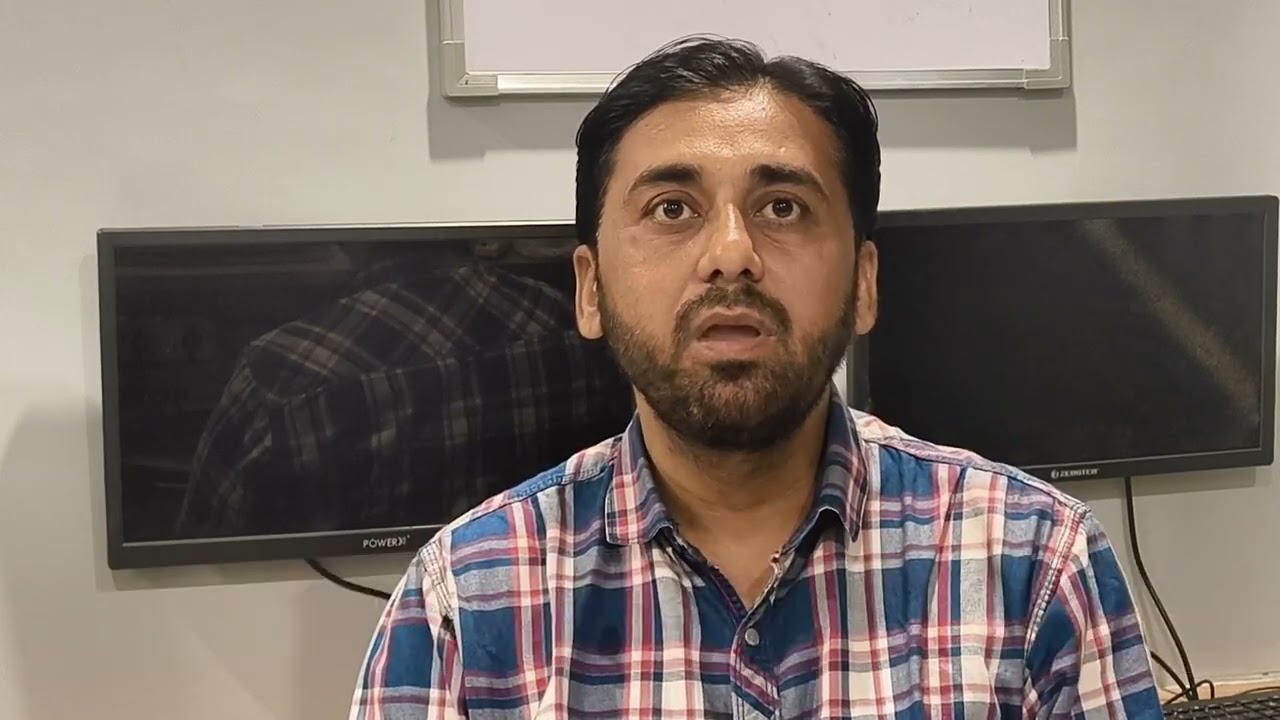
I am a passionate Software Developer and Computer Science tutor with over 10 years of teaching experience. I specialize in helping students understand programming concepts in a simple, practical, and structured way.

My background includes working with technologies such as .NET Core, C#, Flutter, JavaScript, Node.js, and MySQL, along with building real-world applications and software systems. This allows me to teach not just theory, but also how things work in real industry environments.

Over the years, I have taught:
School and college students
Beginners starting coding from scratch
Job seekers preparing for technical interviews
Professionals upgrading their development skills

My teaching approach focuses on:
Breaking down complex topics into simple steps
Hands-on coding and real-time practice
Building small projects to strengthen understanding
Providing personalized guidance based on each student’s level

I believe that anyone can learn programming with the right guidance and consistent practice. My goal is to make learning coding easy, practical, and confidence-building.

If you are looking to build a strong foundation in Computer Science or improve your programming skills for academic or career growth, I am here to help you achieve your goals.
Education
- Master of Computer Applications (MCA) from Veer Narmad South Gujarat University
- Bachelor of Engineering (BE) in Computer Engineering from Gujarat Technological University
Experience / Qualifications
- 10 years of experience as Software Development Engineer
- 10 years of teaching experience as Computer Programming Trainer
Age
Teenagers (13-17 years old)
Adults (18-64 years old)
Seniors (65+ years old)
Student level
Beginner
Intermediate
Advanced
Duration
60 minutes
The class is taught in
English
Hindi
Urdu
Gujarati
Availability of a typical week
(GMT -04:00)
New York
at teacher icon
Online via webcam
Mon
Tue
Wed
Thu
Fri
Sat
Sun
00-04
04-08
08-12
12-16
16-20
20-24
Similar classes
arrow icon previousarrow icon next
verified badge
Most kids think coding is for "smart kids" or "future programmers."
It's not. Coding is how real people solve real problems.
In this class, we skip the theory. Your child creates real things.

What they'll do:
✓ Build real projects in Scratch: a working game, an interactive animation, a story they coded
✓ Program virtual robots: solve real-world challenges (navigate a maze, automate a task, build a system)
✓ Create in Minecraft Education: design worlds, automate constructions, solve logic problems
✓ Experiment with different languages: not just learn "the right way," but understand that there are many ways to think about a problem
✓ Collaborate and share: work with other kids, get feedback, improve their work
✓ Develop logical thinking: not just for coding, but for anything: solving math problems, science challenges, real-world situations


Why this is different:
We don't teach syntax. We teach how programmers think.
Most children's coding courses say "here's the code, copy it." We teach "what problem are we trying to solve? How could we break it into steps? What options do we have?"
When your child learns to think like a programmer, they can learn any language afterward.

What they take home:
A portfolio of 3–4 completed, working projects. The ability to say "I built this." And the deep understanding that code is a tool to make real things happen.

Format: Online or Barcelona | 60–90 min sessions | Flexible pace, no prior experience needed
For curious 8-12 year olds who want to build.
verified badge
Python is one of the best, if not the best, language to start learning programming. It is also one of the most widely used languages today, especially in cutting-edge areas such as machine learning.

This popularity means that Python is constantly evolving. It offers a wide range of tools and libraries, which are free and very varied.

As an aeronautical engineer, I like to share my knowledge and derive satisfaction from it by teaching and motivating others.

I'm used to working with people of different ages. I believe in the importance of segmenting learning, visualizing progress, setting concrete goals and practicing regularly.

Beyond these general principles, there is no magic rule or method. Some approaches work with some students but not with others. Adaptation to individual needs is therefore the main objective of private lessons. So I will do my best to find what motivates and helps my student.
verified badge
As a Franco-Belgian management teacher, I give Excel lessons with passion!
Whether remotely or face-to-face, I offer many examples and exercises to accompany you.
I travel without problem throughout the region of Brussels and its surroundings, for lessons of at least 2 hours. For France, courses are only given remotely.

Here are some key words that will be covered in my classes:
Scenario analysis, Year, Rounding, Today, Bdnb, Bdnbval, Bdsum, Search, Column, Copy/paste in values, Copy/paste with transposition, Consolidation, Date, Datedif, Determat, Dollar, Right, Righterg, Equiv, Esterror, Estna, Frequency, Filter (simple and advanced), Format of cells, Left, Large.Value, Printing of documents, Index, Indirect, Inversemat, Day, Weekday, Line, Matrix, Max, Maxa, Max.Si, Min , Mina, Mina.If, Formatting of cells and ranges, Month, Average, Average.If, Nb, Nb.If, Nbval, Naming of cells and ranges, No, Small.value, Product, Productmat, Protection of cells, Lookup (Lookup), Lookupv (VLookup), Lookuph (HLookup), If (If), If.Not.Disp, If.Conditions, Iferror, Sum, Sumproduct, Sum.If, Sum.If.Set, Substitute , Pivot tables, Sorting, Cell locking

Do not hesitate to contact me to organize your lessons according to your needs and availability. Together, we will develop your Excel skills in an efficient and personalized way.
verified badge
doctoral student in engineering sciences provides support courses in analog and digital electronics at any DEUG level and engineering schools. having scientific and technical knowledge, three years of experience in the field of teaching, pedagogy and a sense of listening and analysis, I am able to help pupils and students and train them in the chapters of which they are having difficulty. for more info please contact me
verified badge
Master Python with Personalized Courses

Discover the art of programming with Python courses tailor-made to meet your specific needs. Whether you are a beginner, intermediate or professional, my lessons are suitable for all levels.

Why Choose My Courses?

Personalized Teaching Approach: Each course is tailored to your skill level and individual goals.

Practical Experience: Learn by doing with real-world projects that build your understanding and skills.

Ongoing Support: Get unlimited email support for any questions you have between sessions.

As a Python expert, I have a passion for teaching and sharing my knowledge. My goal is to guide you effectively in your learning journey.

Book Your First Lesson:

Start your journey to Python mastery now by booking your first lesson. Whether you aspire to enter the development field or hone your existing skills, these courses are designed for you.
verified badge
Experienced and patient teacher of logic for computer science.

I have taught logic, formal languages and automata theory to undergraduates for six years. My tutoring is adapted to the student's level and goals. Whether you need to learn logic for your studies, or you would simply like to know more about the subject, I will be more than happy to help you improve your understanding and skills.

Logic
The sciences presuppose a certain standard of rationality. An ability to distinguish between correct reasoning and claims that do not follow from the assumptions. In this class we study the basic principles of logic and apply mathematical techniques to the study thereof.
Topics include:
Propositional and Predicate Logic
Syntax and semantics
Natural deduction
Semantic tableaux
Correctness and soundness
Completeness

Formal languages and automata
A formal language is an abstraction of general characteristics of programming languages. Such a languages consists of a set of symbols together with some rules to determine whether a string made up out of those symbols is a member of the language.

Topics include:
Regular languages, context-free languages
Finite automata, pushdown automata, Turing machines
Regular expressions
Regular grammar, context-sensitive grammar
Pumping lemmas for regular and context-free languages
verified badge
I teach Python specifically for finance and data applications - the kind used in economics, business analytics, and quantitative programs. This isn't a general "learn to code" course; it's built around real financial data, benchmarking, and the workflows you'll actually use in coursework or early career work.

Topics include:
Python fundamentals through a finance lens (data structures, functions, control flow).
Working with financial data and datasets.
Performance benchmarking and writing efficient code.
Applying concepts from Hilpisch's Python for Finance.
verified badge
With over seven years of experience in teaching Computer Science & Information Technology (ICT), I have developed a strong expertise in delivering high-quality education across multiple internationally recognized curricula, including Cambridge IGCSE, GCSE, A-Levels, O-Levels, and Checkpoint. My passion lies in equipping students with coding, cybersecurity, and digital literacy skills, ensuring they are well-prepared for the evolving demands of the digital world.

Expertise & Teaching Areas:
✅ Programming & Software Development: Python, Java, C++
✅ Cybersecurity: Ethical hacking, data protection, network security
✅ Digital Literacy: ICT applications, online safety, cloud computing
✅ Data Science & AI: Data analysis, machine learning fundamentals
✅ Web Development: HTML, CSS, JavaScript

Curriculum & Pedagogical Experience:
🔹 Cambridge IGCSE & GCSE ICT & Computer Science – Teaching core and extended syllabi, focusing on programming logic, databases, and networking.
🔹 Cambridge A-Levels & O-Levels Computer Science – Preparing students for advanced computing concepts, problem-solving, and algorithm development.
🔹 Cambridge Checkpoint ICT – Building foundational skills in digital technology and computer applications.

Professional Impact:
📌 Mentored students to achieve top grades in Cambridge ICT & Computer Science exams.
📌 Developed interactive lesson plans integrating real-world applications of technology.
📌 Conducted coding boot camps and cybersecurity workshops to enhance practical learning.
📌 Guided students in project-based learning, including app development and website design.

With a strong commitment to student-centered learning and technological innovation, I am dedicated to shaping future tech leaders and empowering learners with skills relevant to careers in technology, data science, and software development.
verified badge
This course introduces students to the fundamentals of Information and Communication Technology (ICT) and its role in modern society. Topics include computer hardware and software, digital communication tools, internet technologies, data management, cybersecurity, and emerging trends. Students will gain practical skills in using productivity software, conducting online research, and understanding the ethical and responsible use of digital resources. The course emphasizes both technical proficiency and digital literacy, preparing learners to confidently navigate and contribute to a technology-driven world.
verified badge
This course is a comprehensive and practical introduction to the WordPress CMS, designed for beginners who want to create, customize, and publish their own website, without writing a single line of code.

🎯 Educational objectives:

1- Understand how WordPress and its interface (back-office) work

2- Install WordPress locally using MAMP

3- Choose, install and customize a theme adapted to your needs

4- Use a builder (like Elementor) to create modern and dynamic pages

5- Create a structured navigation menu

6- Import a pre-built demo to save time

7- Put your site online and learn good maintenance practices

🧰 On the program:

1- Installing the local environment with MAMP

2- Getting started with the WordPress interface

3- Management of pages, articles, media, extensions and settings

4- Visual customization (themes, CSS, builders)

5- Hosting your website online

6- MCQs and practical exercises to validate your knowledge

💡 Who is this course for?

For students, entrepreneurs, freelancers, web enthusiasts, or anyone who wants to create their own website without relying on a developer.
verified badge
This course is designed for anyone interested in learning data science using Python. It provides a hands-on introduction to fundamental data analysis tools such as NumPy, pandas, matplotlib, and seaborn. You'll learn how to manipulate datasets, create visualizations, and lay the foundations for statistical analysis and machine learning.

The course combines theory and practical exercises for effective, practical progress. No prior programming experience is necessary: we'll start with the basics to build solid, usable skills quickly.
verified badge
This fun and interactive course introduces kids and teens to the fundamentals of coding using Scratch, a visual programming language developed by MIT. Students will learn to create games, animations, and interactive stories while developing problem-solving, logical thinking, and creativity skills—all in a playful, drag-and-drop environment!
Who Should Join?
✔ Kids & teens curious about coding and game design
✔ Young learners who enjoy storytelling, art, or technology
✔ Future coders looking for a fun introduction to programming
verified badge
I offer one-to-one Programming tuition in Python, C, and C++, for GCSE Computer Science, A-Level Computing, and university students studying engineering, computer science, or related subjects. Lessons are available online or in person around Birmingham.

What I cover:

Python for beginners and intermediate learners
C and C++ programming
GCSE and A-Level Computer Science (all exam boards)
University coursework support, debugging help, and project guidance
Core concepts: variables, loops, functions, data structures, object-oriented programming, file handling, basic algorithms

How I teach:
I start by understanding exactly where you are — whether that's "I've never coded before" or "I'm stuck on a specific assignment." Then I build lessons around small, practical examples you can actually run and modify yourself. I'm patient with errors (everyone gets them), and I make sure you understand the why behind the code, not just how to copy it. For university students, I can also help with debugging, code reviews, and explaining tricky concepts in plain English.
If you or your child is preparing for exams, working on coursework, or just wants to finally feel comfortable with coding, I'd love to help.
verified badge
A- TOPICS YOU CAN EXPLORE AND MASTER:
1- PYTHON FOUNDATIONS
• Variables, data types, operators, conditional structures, loops, functions, modules, files, exceptions, and object-oriented programming
• Lists, tuples, dictionaries, sets, comprehensions, debugging, and writing clear, reusable, well-structured code
• Jupyter Notebook, Anaconda, Visual Studio Code, virtual environments, and package management

2 — PROGRAMMING, ALGORITHMS, AND COMPUTER SCIENCE FOUNDATIONS
• Algorithmic thinking, problem decomposition, pseudocode, flowcharts, procedural programming, object-oriented programming, recursion, and modular program design
• Fundamental data structures including arrays, lists, stacks, queues, dictionaries/hash tables, sets, trees, graphs, and their appropriate use
• Searching, sorting, traversal, algorithm efficiency, computational complexity, Big-O notation, debugging, testing, code organization, and problem-solving strategies
• Practical programming exercises ranging from beginner problems to university-level algorithmic and computational challenges

3- DATA PREPARATION AND EXPLORATION
• NumPy and pandas for importing, cleaning, transforming, filtering, grouping, reshaping, and merging data
• Missing values, duplicates, outliers, inconsistent formats, data leakage, and data-quality validation
• Exploratory data analysis using descriptive statistics, Matplotlib, Seaborn, and graphical interpretation

4- MATHEMATICAL FOUNDATIONS
• Linear algebra, vectors, matrices, derivatives, optimization, probability, and statistics
• Loss functions, gradients, distance measures, regularization, likelihood, and model complexity
• Mathematical concepts are explained according to the learner’s level and the requirements of the selected algorithms

5- SUPERVISED MACHINE LEARNING
• Linear and polynomial regression, logistic regression, and regularized models
• k-nearest neighbours, decision trees, random forests, gradient boosting, support vector machines, and Naive Bayes classifiers
• Classification, regression, model assumptions, decision boundaries, feature importance, and interpretation of results

6- UNSUPERVISED LEARNING
• Clustering using k-means, hierarchical clustering, and density-based methods
• Principal component analysis, dimensionality reduction, anomaly detection, and pattern or structure discovery
• Method selection, evaluation of data structure, and interpretation of results without predefined labels

7- MODEL EVALUATION AND IMPROVEMENT
• Training, validation, and test sets; cross-validation; hyperparameter optimization
• Accuracy, precision, recall, specificity, F1 score, ROC–AUC, confusion matrices, MAE, MSE, RMSE, and R2
• Underfitting, overfitting, bias–variance trade-off, class imbalance, feature engineering, feature selection, scaling, and regularization

8- DEEP LEARNING
• Neural-network foundations, activation functions, forward propagation, backpropagation, and gradient descent
• Multilayer perceptrons, convolutional neural networks, recurrent neural networks, and Transformer foundations
• TensorFlow, Keras, or PyTorch depending on the learner’s project and working environment

9- ARTIFICIAL INTELLIGENCE APPLICATIONS
• Natural language processing, text classification, embeddings, sentiment analysis, and foundations of language models
• Computer vision, image classification, fundamental principles of object detection, and image preprocessing
• Recommendation systems, forecasting, anomaly detection, intelligent automation, and decision-support applications

10- GENERATIVE AI AND LARGE LANGUAGE MODELS
• Transformer architecture, tokens, embeddings, attention mechanisms, prompt engineering, Retrieval-Augmented Generation (RAG), and model evaluation
• Use of artificial-intelligence APIs, vector databases, document-retrieval systems, and structured AI-enabled workflows when relevant
• Reliability, hallucinations, bias, privacy, responsible use, and appropriate human validation

11- TOOLS AND LIBRARIES
• Python, NumPy, pandas, Matplotlib, Seaborn, scikit-learn, SciPy, Statsmodels, TensorFlow, Keras, and PyTorch
• Jupyter Notebook, Anaconda, Visual Studio Code, Git, GitHub, SQL, Excel, and Power BI when useful to the project
• Additional libraries may be introduced depending on the selected specialization and dataset

12- PROJECTS, RESEARCH, AND INTERVIEW PREPARATION
• Complete projects covering data preparation, model development, evaluation, interpretation, and presentation of results
• University assignments, dissertations, theses, research projects, portfolio projects, technical interviews, and professional applications
• Code review, debugging, documentation, reproducibility, model comparison, and communication of results

-------------------------------------------------------------------------------------------------------------------------------------------------------------------------------
B- PERSONALIZED TUTORING: LEARNING HOW TO REASON
Machine learning and artificial intelligence become much more accessible when mathematics, algorithms, Python code, data, and real-world applications are clearly connected.

My lessons help you move beyond simply copying code or using models as “black boxes.” You will learn how to define the problem correctly, prepare the data, select an appropriate algorithm, understand how it works, train and evaluate the model, diagnose errors, improve performance, and interpret results rigorously and responsibly.

Each lesson is personalized according to your current level, mathematical background, programming experience, dataset, university work, research project, interview preparation, or professional objective. We begin by identifying your existing knowledge, software environment, expected outcomes, and main conceptual or technical difficulties. We then establish a structured learning plan.

The first lesson combines a discussion of your background, objectives, and tutoring needs; an initial assessment of your current knowledge; personalized planning and organization of future sessions; and a short trial lesson to determine the most effective learning approach.

A typical session may include conceptual explanation, development of mathematical intuition, live coding, guided implementation, model evaluation, technical problem solving, and a concise summary of the next steps.

You may work with your own dataset, university assignment, research project, or professional problem, provided that confidential information is handled appropriately. I can also provide structured examples and datasets suited to your level.

My goal is not simply to help you run an algorithm. It is to help you understand why it is appropriate, how it learns from data, how to evaluate it correctly, why it may fail, and how to build a reliable, interpretable, and scientifically rigorous solution.
verified badge
This hands-on training pathway is designed to help students kickstart any project, specifically tailored for OT labs and industrial applications. Starting from absolute scratch, students will build a strong foundation in Python programming through practical, industry-relevant concepts.

Curriculum Outline: |
01 - Python Environment Setup & Basics |
02 - Python Variables, Numbers, Bytes & Hex |
03 - Control Flow Logic Functions |
04 - Data Structures (Lists, Tuples, Dictionaries & Sets) |
05 - String Formatting, Comprehensions & Exception Handling |
06 - File IO, Pathlib & Context Managers |
07 - Object-Oriented Programming (Classes & OOP) |
08 - Standard Library, Modules & Networking Basics |

Assessment & Evaluation:
Students will take a mini-test after the completion of each module. Additionally, an Audit & Performance Evaluation report will be sent following the tests.
Duration:
5 days to 15 days (depending on the pace of the cohort)
Video thumbnail
Play icon
Mohammedirfan's video
message icon
Contact Mohammedirfan
repeat students icon
1st lesson is backed
by our
Good-fit Instructor Guarantee
Similar classes
arrow icon previousarrow icon next
verified badge
Most kids think coding is for "smart kids" or "future programmers."
It's not. Coding is how real people solve real problems.
In this class, we skip the theory. Your child creates real things.

What they'll do:
✓ Build real projects in Scratch: a working game, an interactive animation, a story they coded
✓ Program virtual robots: solve real-world challenges (navigate a maze, automate a task, build a system)
✓ Create in Minecraft Education: design worlds, automate constructions, solve logic problems
✓ Experiment with different languages: not just learn "the right way," but understand that there are many ways to think about a problem
✓ Collaborate and share: work with other kids, get feedback, improve their work
✓ Develop logical thinking: not just for coding, but for anything: solving math problems, science challenges, real-world situations


Why this is different:
We don't teach syntax. We teach how programmers think.
Most children's coding courses say "here's the code, copy it." We teach "what problem are we trying to solve? How could we break it into steps? What options do we have?"
When your child learns to think like a programmer, they can learn any language afterward.

What they take home:
A portfolio of 3–4 completed, working projects. The ability to say "I built this." And the deep understanding that code is a tool to make real things happen.

Format: Online or Barcelona | 60–90 min sessions | Flexible pace, no prior experience needed
For curious 8-12 year olds who want to build.
verified badge
Python is one of the best, if not the best, language to start learning programming. It is also one of the most widely used languages today, especially in cutting-edge areas such as machine learning.

This popularity means that Python is constantly evolving. It offers a wide range of tools and libraries, which are free and very varied.

As an aeronautical engineer, I like to share my knowledge and derive satisfaction from it by teaching and motivating others.

I'm used to working with people of different ages. I believe in the importance of segmenting learning, visualizing progress, setting concrete goals and practicing regularly.

Beyond these general principles, there is no magic rule or method. Some approaches work with some students but not with others. Adaptation to individual needs is therefore the main objective of private lessons. So I will do my best to find what motivates and helps my student.
verified badge
As a Franco-Belgian management teacher, I give Excel lessons with passion!
Whether remotely or face-to-face, I offer many examples and exercises to accompany you.
I travel without problem throughout the region of Brussels and its surroundings, for lessons of at least 2 hours. For France, courses are only given remotely.

Here are some key words that will be covered in my classes:
Scenario analysis, Year, Rounding, Today, Bdnb, Bdnbval, Bdsum, Search, Column, Copy/paste in values, Copy/paste with transposition, Consolidation, Date, Datedif, Determat, Dollar, Right, Righterg, Equiv, Esterror, Estna, Frequency, Filter (simple and advanced), Format of cells, Left, Large.Value, Printing of documents, Index, Indirect, Inversemat, Day, Weekday, Line, Matrix, Max, Maxa, Max.Si, Min , Mina, Mina.If, Formatting of cells and ranges, Month, Average, Average.If, Nb, Nb.If, Nbval, Naming of cells and ranges, No, Small.value, Product, Productmat, Protection of cells, Lookup (Lookup), Lookupv (VLookup), Lookuph (HLookup), If (If), If.Not.Disp, If.Conditions, Iferror, Sum, Sumproduct, Sum.If, Sum.If.Set, Substitute , Pivot tables, Sorting, Cell locking

Do not hesitate to contact me to organize your lessons according to your needs and availability. Together, we will develop your Excel skills in an efficient and personalized way.
verified badge
doctoral student in engineering sciences provides support courses in analog and digital electronics at any DEUG level and engineering schools. having scientific and technical knowledge, three years of experience in the field of teaching, pedagogy and a sense of listening and analysis, I am able to help pupils and students and train them in the chapters of which they are having difficulty. for more info please contact me
verified badge
Master Python with Personalized Courses

Discover the art of programming with Python courses tailor-made to meet your specific needs. Whether you are a beginner, intermediate or professional, my lessons are suitable for all levels.

Why Choose My Courses?

Personalized Teaching Approach: Each course is tailored to your skill level and individual goals.

Practical Experience: Learn by doing with real-world projects that build your understanding and skills.

Ongoing Support: Get unlimited email support for any questions you have between sessions.

As a Python expert, I have a passion for teaching and sharing my knowledge. My goal is to guide you effectively in your learning journey.

Book Your First Lesson:

Start your journey to Python mastery now by booking your first lesson. Whether you aspire to enter the development field or hone your existing skills, these courses are designed for you.
verified badge
Experienced and patient teacher of logic for computer science.

I have taught logic, formal languages and automata theory to undergraduates for six years. My tutoring is adapted to the student's level and goals. Whether you need to learn logic for your studies, or you would simply like to know more about the subject, I will be more than happy to help you improve your understanding and skills.

Logic
The sciences presuppose a certain standard of rationality. An ability to distinguish between correct reasoning and claims that do not follow from the assumptions. In this class we study the basic principles of logic and apply mathematical techniques to the study thereof.
Topics include:
Propositional and Predicate Logic
Syntax and semantics
Natural deduction
Semantic tableaux
Correctness and soundness
Completeness

Formal languages and automata
A formal language is an abstraction of general characteristics of programming languages. Such a languages consists of a set of symbols together with some rules to determine whether a string made up out of those symbols is a member of the language.

Topics include:
Regular languages, context-free languages
Finite automata, pushdown automata, Turing machines
Regular expressions
Regular grammar, context-sensitive grammar
Pumping lemmas for regular and context-free languages
verified badge
I teach Python specifically for finance and data applications - the kind used in economics, business analytics, and quantitative programs. This isn't a general "learn to code" course; it's built around real financial data, benchmarking, and the workflows you'll actually use in coursework or early career work.

Topics include:
Python fundamentals through a finance lens (data structures, functions, control flow).
Working with financial data and datasets.
Performance benchmarking and writing efficient code.
Applying concepts from Hilpisch's Python for Finance.
verified badge
With over seven years of experience in teaching Computer Science & Information Technology (ICT), I have developed a strong expertise in delivering high-quality education across multiple internationally recognized curricula, including Cambridge IGCSE, GCSE, A-Levels, O-Levels, and Checkpoint. My passion lies in equipping students with coding, cybersecurity, and digital literacy skills, ensuring they are well-prepared for the evolving demands of the digital world.

Expertise & Teaching Areas:
✅ Programming & Software Development: Python, Java, C++
✅ Cybersecurity: Ethical hacking, data protection, network security
✅ Digital Literacy: ICT applications, online safety, cloud computing
✅ Data Science & AI: Data analysis, machine learning fundamentals
✅ Web Development: HTML, CSS, JavaScript

Curriculum & Pedagogical Experience:
🔹 Cambridge IGCSE & GCSE ICT & Computer Science – Teaching core and extended syllabi, focusing on programming logic, databases, and networking.
🔹 Cambridge A-Levels & O-Levels Computer Science – Preparing students for advanced computing concepts, problem-solving, and algorithm development.
🔹 Cambridge Checkpoint ICT – Building foundational skills in digital technology and computer applications.

Professional Impact:
📌 Mentored students to achieve top grades in Cambridge ICT & Computer Science exams.
📌 Developed interactive lesson plans integrating real-world applications of technology.
📌 Conducted coding boot camps and cybersecurity workshops to enhance practical learning.
📌 Guided students in project-based learning, including app development and website design.

With a strong commitment to student-centered learning and technological innovation, I am dedicated to shaping future tech leaders and empowering learners with skills relevant to careers in technology, data science, and software development.
verified badge
This course introduces students to the fundamentals of Information and Communication Technology (ICT) and its role in modern society. Topics include computer hardware and software, digital communication tools, internet technologies, data management, cybersecurity, and emerging trends. Students will gain practical skills in using productivity software, conducting online research, and understanding the ethical and responsible use of digital resources. The course emphasizes both technical proficiency and digital literacy, preparing learners to confidently navigate and contribute to a technology-driven world.
verified badge
This course is a comprehensive and practical introduction to the WordPress CMS, designed for beginners who want to create, customize, and publish their own website, without writing a single line of code.

🎯 Educational objectives:

1- Understand how WordPress and its interface (back-office) work

2- Install WordPress locally using MAMP

3- Choose, install and customize a theme adapted to your needs

4- Use a builder (like Elementor) to create modern and dynamic pages

5- Create a structured navigation menu

6- Import a pre-built demo to save time

7- Put your site online and learn good maintenance practices

🧰 On the program:

1- Installing the local environment with MAMP

2- Getting started with the WordPress interface

3- Management of pages, articles, media, extensions and settings

4- Visual customization (themes, CSS, builders)

5- Hosting your website online

6- MCQs and practical exercises to validate your knowledge

💡 Who is this course for?

For students, entrepreneurs, freelancers, web enthusiasts, or anyone who wants to create their own website without relying on a developer.
verified badge
This course is designed for anyone interested in learning data science using Python. It provides a hands-on introduction to fundamental data analysis tools such as NumPy, pandas, matplotlib, and seaborn. You'll learn how to manipulate datasets, create visualizations, and lay the foundations for statistical analysis and machine learning.

The course combines theory and practical exercises for effective, practical progress. No prior programming experience is necessary: we'll start with the basics to build solid, usable skills quickly.
verified badge
This fun and interactive course introduces kids and teens to the fundamentals of coding using Scratch, a visual programming language developed by MIT. Students will learn to create games, animations, and interactive stories while developing problem-solving, logical thinking, and creativity skills—all in a playful, drag-and-drop environment!
Who Should Join?
✔ Kids & teens curious about coding and game design
✔ Young learners who enjoy storytelling, art, or technology
✔ Future coders looking for a fun introduction to programming
verified badge
I offer one-to-one Programming tuition in Python, C, and C++, for GCSE Computer Science, A-Level Computing, and university students studying engineering, computer science, or related subjects. Lessons are available online or in person around Birmingham.

What I cover:

Python for beginners and intermediate learners
C and C++ programming
GCSE and A-Level Computer Science (all exam boards)
University coursework support, debugging help, and project guidance
Core concepts: variables, loops, functions, data structures, object-oriented programming, file handling, basic algorithms

How I teach:
I start by understanding exactly where you are — whether that's "I've never coded before" or "I'm stuck on a specific assignment." Then I build lessons around small, practical examples you can actually run and modify yourself. I'm patient with errors (everyone gets them), and I make sure you understand the why behind the code, not just how to copy it. For university students, I can also help with debugging, code reviews, and explaining tricky concepts in plain English.
If you or your child is preparing for exams, working on coursework, or just wants to finally feel comfortable with coding, I'd love to help.
verified badge
A- TOPICS YOU CAN EXPLORE AND MASTER:
1- PYTHON FOUNDATIONS
• Variables, data types, operators, conditional structures, loops, functions, modules, files, exceptions, and object-oriented programming
• Lists, tuples, dictionaries, sets, comprehensions, debugging, and writing clear, reusable, well-structured code
• Jupyter Notebook, Anaconda, Visual Studio Code, virtual environments, and package management

2 — PROGRAMMING, ALGORITHMS, AND COMPUTER SCIENCE FOUNDATIONS
• Algorithmic thinking, problem decomposition, pseudocode, flowcharts, procedural programming, object-oriented programming, recursion, and modular program design
• Fundamental data structures including arrays, lists, stacks, queues, dictionaries/hash tables, sets, trees, graphs, and their appropriate use
• Searching, sorting, traversal, algorithm efficiency, computational complexity, Big-O notation, debugging, testing, code organization, and problem-solving strategies
• Practical programming exercises ranging from beginner problems to university-level algorithmic and computational challenges

3- DATA PREPARATION AND EXPLORATION
• NumPy and pandas for importing, cleaning, transforming, filtering, grouping, reshaping, and merging data
• Missing values, duplicates, outliers, inconsistent formats, data leakage, and data-quality validation
• Exploratory data analysis using descriptive statistics, Matplotlib, Seaborn, and graphical interpretation

4- MATHEMATICAL FOUNDATIONS
• Linear algebra, vectors, matrices, derivatives, optimization, probability, and statistics
• Loss functions, gradients, distance measures, regularization, likelihood, and model complexity
• Mathematical concepts are explained according to the learner’s level and the requirements of the selected algorithms

5- SUPERVISED MACHINE LEARNING
• Linear and polynomial regression, logistic regression, and regularized models
• k-nearest neighbours, decision trees, random forests, gradient boosting, support vector machines, and Naive Bayes classifiers
• Classification, regression, model assumptions, decision boundaries, feature importance, and interpretation of results

6- UNSUPERVISED LEARNING
• Clustering using k-means, hierarchical clustering, and density-based methods
• Principal component analysis, dimensionality reduction, anomaly detection, and pattern or structure discovery
• Method selection, evaluation of data structure, and interpretation of results without predefined labels

7- MODEL EVALUATION AND IMPROVEMENT
• Training, validation, and test sets; cross-validation; hyperparameter optimization
• Accuracy, precision, recall, specificity, F1 score, ROC–AUC, confusion matrices, MAE, MSE, RMSE, and R2
• Underfitting, overfitting, bias–variance trade-off, class imbalance, feature engineering, feature selection, scaling, and regularization

8- DEEP LEARNING
• Neural-network foundations, activation functions, forward propagation, backpropagation, and gradient descent
• Multilayer perceptrons, convolutional neural networks, recurrent neural networks, and Transformer foundations
• TensorFlow, Keras, or PyTorch depending on the learner’s project and working environment

9- ARTIFICIAL INTELLIGENCE APPLICATIONS
• Natural language processing, text classification, embeddings, sentiment analysis, and foundations of language models
• Computer vision, image classification, fundamental principles of object detection, and image preprocessing
• Recommendation systems, forecasting, anomaly detection, intelligent automation, and decision-support applications

10- GENERATIVE AI AND LARGE LANGUAGE MODELS
• Transformer architecture, tokens, embeddings, attention mechanisms, prompt engineering, Retrieval-Augmented Generation (RAG), and model evaluation
• Use of artificial-intelligence APIs, vector databases, document-retrieval systems, and structured AI-enabled workflows when relevant
• Reliability, hallucinations, bias, privacy, responsible use, and appropriate human validation

11- TOOLS AND LIBRARIES
• Python, NumPy, pandas, Matplotlib, Seaborn, scikit-learn, SciPy, Statsmodels, TensorFlow, Keras, and PyTorch
• Jupyter Notebook, Anaconda, Visual Studio Code, Git, GitHub, SQL, Excel, and Power BI when useful to the project
• Additional libraries may be introduced depending on the selected specialization and dataset

12- PROJECTS, RESEARCH, AND INTERVIEW PREPARATION
• Complete projects covering data preparation, model development, evaluation, interpretation, and presentation of results
• University assignments, dissertations, theses, research projects, portfolio projects, technical interviews, and professional applications
• Code review, debugging, documentation, reproducibility, model comparison, and communication of results

-------------------------------------------------------------------------------------------------------------------------------------------------------------------------------
B- PERSONALIZED TUTORING: LEARNING HOW TO REASON
Machine learning and artificial intelligence become much more accessible when mathematics, algorithms, Python code, data, and real-world applications are clearly connected.

My lessons help you move beyond simply copying code or using models as “black boxes.” You will learn how to define the problem correctly, prepare the data, select an appropriate algorithm, understand how it works, train and evaluate the model, diagnose errors, improve performance, and interpret results rigorously and responsibly.

Each lesson is personalized according to your current level, mathematical background, programming experience, dataset, university work, research project, interview preparation, or professional objective. We begin by identifying your existing knowledge, software environment, expected outcomes, and main conceptual or technical difficulties. We then establish a structured learning plan.

The first lesson combines a discussion of your background, objectives, and tutoring needs; an initial assessment of your current knowledge; personalized planning and organization of future sessions; and a short trial lesson to determine the most effective learning approach.

A typical session may include conceptual explanation, development of mathematical intuition, live coding, guided implementation, model evaluation, technical problem solving, and a concise summary of the next steps.

You may work with your own dataset, university assignment, research project, or professional problem, provided that confidential information is handled appropriately. I can also provide structured examples and datasets suited to your level.

My goal is not simply to help you run an algorithm. It is to help you understand why it is appropriate, how it learns from data, how to evaluate it correctly, why it may fail, and how to build a reliable, interpretable, and scientifically rigorous solution.
verified badge
This hands-on training pathway is designed to help students kickstart any project, specifically tailored for OT labs and industrial applications. Starting from absolute scratch, students will build a strong foundation in Python programming through practical, industry-relevant concepts.

Curriculum Outline: |
01 - Python Environment Setup & Basics |
02 - Python Variables, Numbers, Bytes & Hex |
03 - Control Flow Logic Functions |
04 - Data Structures (Lists, Tuples, Dictionaries & Sets) |
05 - String Formatting, Comprehensions & Exception Handling |
06 - File IO, Pathlib & Context Managers |
07 - Object-Oriented Programming (Classes & OOP) |
08 - Standard Library, Modules & Networking Basics |

Assessment & Evaluation:
Students will take a mini-test after the completion of each module. Additionally, an Audit & Performance Evaluation report will be sent following the tests.
Duration:
5 days to 15 days (depending on the pace of the cohort)
Good-fit Instructor Guarantee
favorite button
message icon
Contact Mohammedirfan