

1/3


Activo recientemente


Profesor fiable
Este profe tiene una tasa de respuesta rápida muy elevada, ofreciendo así un servicio de buena calidad y fiabilidad a sus estudiantes.

Desde octubre 2025
Profesor desde octubre 2025

5 estudiantes regulares
La opción de confianza para 5 estudiantes recurrentes
Advanced Mathematics: Bachelor's,

A partir de 26.46 $ /h

1. Algebra & Linear Algebra
The foundation for success in mathematics. General algebra: Groups, rings, fields, and arithmetic.
Linear algebra: Vector spaces, reduction of endomorphisms (diagonalization, triangularization), duality, and quadratic forms.
2. Topology & Functional Analysis
To move from simple function analysis to the study of space structures.
Metric spaces & Topology: Open and closed sets, compactness, connectivity, and completeness.
Normated Vector Spaces: Convergence of sequences, continuity, and equivalence of norms.
Banach & Hilbert spaces: Study of completeness, orthogonal projections, Riesz theorems, and Fourier series. 3. Numerical Analysis The art of solving mathematical problems through algorithms and high-performance computing.
Solving nonlinear equations: Bisection, Newton-Raphson, and fixed-point methods.
Numerical integration: Trapezoidal rule and Simpson's rule.
Numerical matrix analysis: Solving systems of equations (Gzuss, Lu, Cholesky), eigenvalue calculations, and conditional analysis.
The foundation for success in mathematics. General algebra: Groups, rings, fields, and arithmetic.
Linear algebra: Vector spaces, reduction of endomorphisms (diagonalization, triangularization), duality, and quadratic forms.
2. Topology & Functional Analysis
To move from simple function analysis to the study of space structures.
Metric spaces & Topology: Open and closed sets, compactness, connectivity, and completeness.
Normated Vector Spaces: Convergence of sequences, continuity, and equivalence of norms.
Banach & Hilbert spaces: Study of completeness, orthogonal projections, Riesz theorems, and Fourier series. 3. Numerical Analysis The art of solving mathematical problems through algorithms and high-performance computing.
Solving nonlinear equations: Bisection, Newton-Raphson, and fixed-point methods.
Numerical integration: Trapezoidal rule and Simpson's rule.
Numerical matrix analysis: Solving systems of equations (Gzuss, Lu, Cholesky), eigenvalue calculations, and conditional analysis.
Información adicional
PC
Lugar

Conectado desde Luxemburgo
Acerca de mí
Bonjour, je suis Dr. Raouf, titulaire d'un Doctorat en Mathématiques avec une solide expérience dans l'enseignement supérieur et le soutien scolaire personnalisé. J'accompagne les élèves des lycées luxembourgeois (Classique et Général) ainsi que les étudiants universitaires vers l'excellence.
Ma pédagogie repose sur la simplification des concepts abstraits et la maîtrise des méthodes de résolution exigées par le Ministère de l'Éducation nationale du Luxembourg ESC (Classique) et ESG (Général).
1. Enseignement Secondaire (Sections B, C, D, G)
Analyse : Étude approfondie des fonctions (logarithmes, exponentielles), limites, dérivées et calcul intégral.
Algèbre Linéaire : Géométrie analytique dans l'espace, vecteurs, et systèmes d'équations (méthode de Gauss).
Nombres Complexes : Formes algébriques, trigonométriques et résolution dans .
Préparation à l'Examen de Fin d'Études :Travail intensif sur les questionnaires des années précédentes (Annales).
2. Enseignement Supérieur (Université du Luxembourg / CPGE)
Calculus & Analyse réelle : Suites, séries, intégrales généralisées.
Algèbre matricielle : Espaces vectoriels, diagonalisation, valeurs propres.
Ma Méthodologie en Ligne
Outils digitaux : Utilisation d'un tableau blanc interactif et d'une tablette graphique pour une rédaction claire et partagée en temps réel.
Adaptation stricte aux barèmes et aux critères de rédaction du baccalauréat luxembourgeois.
Suivi personnalisé : Envoi d'un résumé de cours et d'exercices d'application après chaque séance.
Ma pédagogie repose sur la simplification des concepts abstraits et la maîtrise des méthodes de résolution exigées par le Ministère de l'Éducation nationale du Luxembourg ESC (Classique) et ESG (Général).
1. Enseignement Secondaire (Sections B, C, D, G)
Analyse : Étude approfondie des fonctions (logarithmes, exponentielles), limites, dérivées et calcul intégral.
Algèbre Linéaire : Géométrie analytique dans l'espace, vecteurs, et systèmes d'équations (méthode de Gauss).
Nombres Complexes : Formes algébriques, trigonométriques et résolution dans .
Préparation à l'Examen de Fin d'Études :Travail intensif sur les questionnaires des années précédentes (Annales).
2. Enseignement Supérieur (Université du Luxembourg / CPGE)
Calculus & Analyse réelle : Suites, séries, intégrales généralisées.
Algèbre matricielle : Espaces vectoriels, diagonalisation, valeurs propres.
Ma Méthodologie en Ligne
Outils digitaux : Utilisation d'un tableau blanc interactif et d'une tablette graphique pour une rédaction claire et partagée en temps réel.
Adaptation stricte aux barèmes et aux critères de rédaction du baccalauréat luxembourgeois.
Suivi personnalisé : Envoi d'un résumé de cours et d'exercices d'application après chaque séance.
Formación
Mastère en mathématiques. PhD en mathématiques appliquées. Chercheur en mathématiques au laboratoire de modélisation de l'école nationale d'ingénieurs de Tunis. Mes champs de compétences en mathématiques s'étendent des bases à acquérir pendant l'enseignement secondaire aux mathématiques supérieures de la licence et du mastere en maths et des classes préparatoires aux études d'ingénieurs. Je maîtrise aussi les programmes d'analyse numérique et d'analyse fonctionnelles enseignés notamment dans les écoles d'ingénieurs.
Experiencia / Calificaciones
Une carrière de plus de 20 ans dans une école d'ingénieur en Tunisie dont les programmes de formation sont accrédités EUR-ACE.
Edad
Adolescentes (13-17 años)
Adultos (18-64 años)
Nivel del estudiante
Principiante
Intermedio
Avanzado
Duración
60 minutos
La clase se imparte en
francés
inglés
árabe
Habilidades

Comentarios
Disponibilidad en una semana típica.
(GMT -04:00)
Nueva York

En línea vía webcam
Mon
Tue
Wed
Thu
Fri
Sat
Sun
00-04
04-08
08-12
12-16
16-20
20-24
Objective: To understand AI without fear, to use it to simplify one's life and to know how to identify digital traps.
1: Demystifying AI (What exactly is it?)
AI is not a movie robot: Difference between fiction and reality.
How it works (simply): The image of the "giant library": AI has read billions of books and uses them to predict the continuation of a sentence or create an image.
Where is it already present? Spell checkers, Netflix/YouTube suggestions, GPS, and voice assistants (Siri/Alexa).
2: Using AI to make life easier
Conversing with AI (ChatGPT, Claude, Gemini):
Ask him to write an administrative email or a complex letter.
Summarize a long newspaper article or document.
Plan a travel itinerary or find recipe ideas with what's left in the fridge.
AI for creativity and memory:
Generate images to illustrate a birthday card (Midjourney, DALL-E).
Using AI to restore or colorize old family photos.
3: Learning to "talk" to AI (The Art of the Prompt)
The context method: Why "Give me a cake recipe" is less effective than "I am allergic to gluten and I am hosting 4 people, give me a simple chocolate cake recipe".
The expert's role: Learning to tell AI "Act like a travel guide" or "Act like an expert gardener".
4: Precautions and Critical Thinking (The Survival Guide)
"Hallucinations": Understand that AI can make false claims with complete certainty (never take medical or legal advice from AI without verification).
Privacy protection:
Never give sensitive data (social security number, passwords, bank details) to an AI.
Knowing that everything we write to the AI is potentially used to train it.
Spotting "Deepfakes":
How to recognize a doctored image or video (details on the hands, strange reflections, slightly metallic voice).
Verify the information: the golden rule of cross-referencing sources.
5: Ethics and Impacts (To go further)
Copyright: Who owns an image created by AI?
The environmental impact: The water and energy consumption of AI servers.
The future: Will AI replace us or assist us?
1: Demystifying AI (What exactly is it?)
AI is not a movie robot: Difference between fiction and reality.
How it works (simply): The image of the "giant library": AI has read billions of books and uses them to predict the continuation of a sentence or create an image.
Where is it already present? Spell checkers, Netflix/YouTube suggestions, GPS, and voice assistants (Siri/Alexa).
2: Using AI to make life easier
Conversing with AI (ChatGPT, Claude, Gemini):
Ask him to write an administrative email or a complex letter.
Summarize a long newspaper article or document.
Plan a travel itinerary or find recipe ideas with what's left in the fridge.
AI for creativity and memory:
Generate images to illustrate a birthday card (Midjourney, DALL-E).
Using AI to restore or colorize old family photos.
3: Learning to "talk" to AI (The Art of the Prompt)
The context method: Why "Give me a cake recipe" is less effective than "I am allergic to gluten and I am hosting 4 people, give me a simple chocolate cake recipe".
The expert's role: Learning to tell AI "Act like a travel guide" or "Act like an expert gardener".
4: Precautions and Critical Thinking (The Survival Guide)
"Hallucinations": Understand that AI can make false claims with complete certainty (never take medical or legal advice from AI without verification).
Privacy protection:
Never give sensitive data (social security number, passwords, bank details) to an AI.
Knowing that everything we write to the AI is potentially used to train it.
Spotting "Deepfakes":
How to recognize a doctored image or video (details on the hands, strange reflections, slightly metallic voice).
Verify the information: the golden rule of cross-referencing sources.
5: Ethics and Impacts (To go further)
Copyright: Who owns an image created by AI?
The environmental impact: The water and energy consumption of AI servers.
The future: Will AI replace us or assist us?
As an experienced mathematics teacher, I offer online private tutoring for high school and university students in Belgium, France, and Switzerland. My courses cover the entire curriculum, from secondary school through the first years of university in science, economics, or engineering.
- For high school students: strengthening of the basics in algebra, geometry and analysis, homework help, preparation for official exams (Higher Secondary Education Certificate, Baccalaureate, specific tests).
- For students: advanced university mathematics with a focus on analysis, linear algebra and numerical methods.
My teaching methods are adapted to the online format, with clear explanations, interactive exercises, and personalized support to ensure progress. The first session is for a precise assessment of your needs.
Key points
- Flexible courses (1 to 2 hours per session) via videoconference using Zoom or Teams.
- Use of digital tools to facilitate understanding (interactive whiteboards, screen sharing).
- Direct application to Belgian programs and requirements of school and university examinations.
- For high school students: strengthening of the basics in algebra, geometry and analysis, homework help, preparation for official exams (Higher Secondary Education Certificate, Baccalaureate, specific tests).
- For students: advanced university mathematics with a focus on analysis, linear algebra and numerical methods.
My teaching methods are adapted to the online format, with clear explanations, interactive exercises, and personalized support to ensure progress. The first session is for a precise assessment of your needs.
Key points
- Flexible courses (1 to 2 hours per session) via videoconference using Zoom or Teams.
- Use of digital tools to facilitate understanding (interactive whiteboards, screen sharing).
- Direct application to Belgian programs and requirements of school and university examinations.
Mostrar más
Clases similares


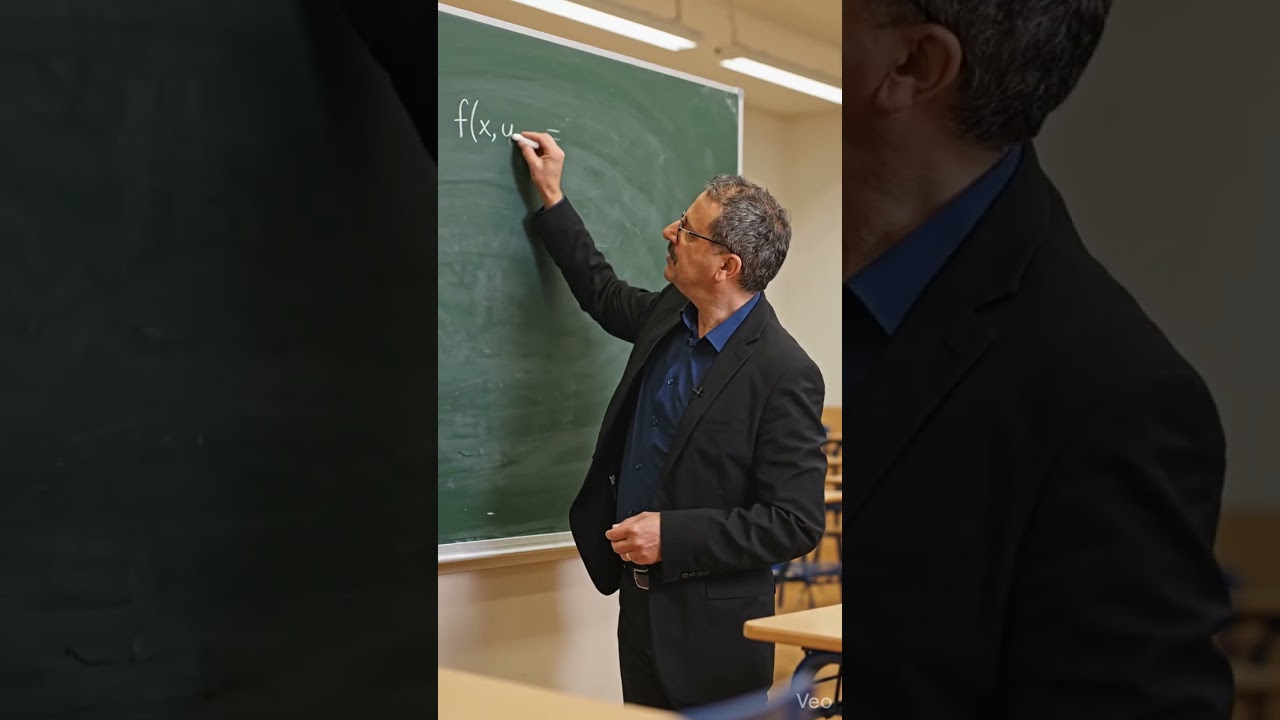

Video de Raouf

Contactar con Raouf

La primera clase está respaldada
por nuestra Garantía del Buen Profesor
por nuestra Garantía del Buen Profesor
Clases similares
Garantía del Buen Profesor
Contactar con Raouf